
Written By Smile Ndubuisi
She knows her period is coming. She counts the days with quiet fear—not because of pain, but because she has no pad. School is in session. Staying home means questions. Going out without protection means humiliation. Somewhere between those two fears, an offer appears. A pad, or money for one, at a cost she never consented to, but feels she has no power to refuse.
This is the reality behind what has come to be known as “sex for pads.” When I first heard about this, I was literally traumatized the whole day. I couldn’t get around how humans will find this as a means to exploit. Just then, I decided I was going to do my findings and raise an alarm on this societal cancer. Unfortunately, it is not a rumor. It is not an exaggeration. It is a form of sexual exploitation quietly thriving where poverty, gender inequality, and menstrual stigma intersect.
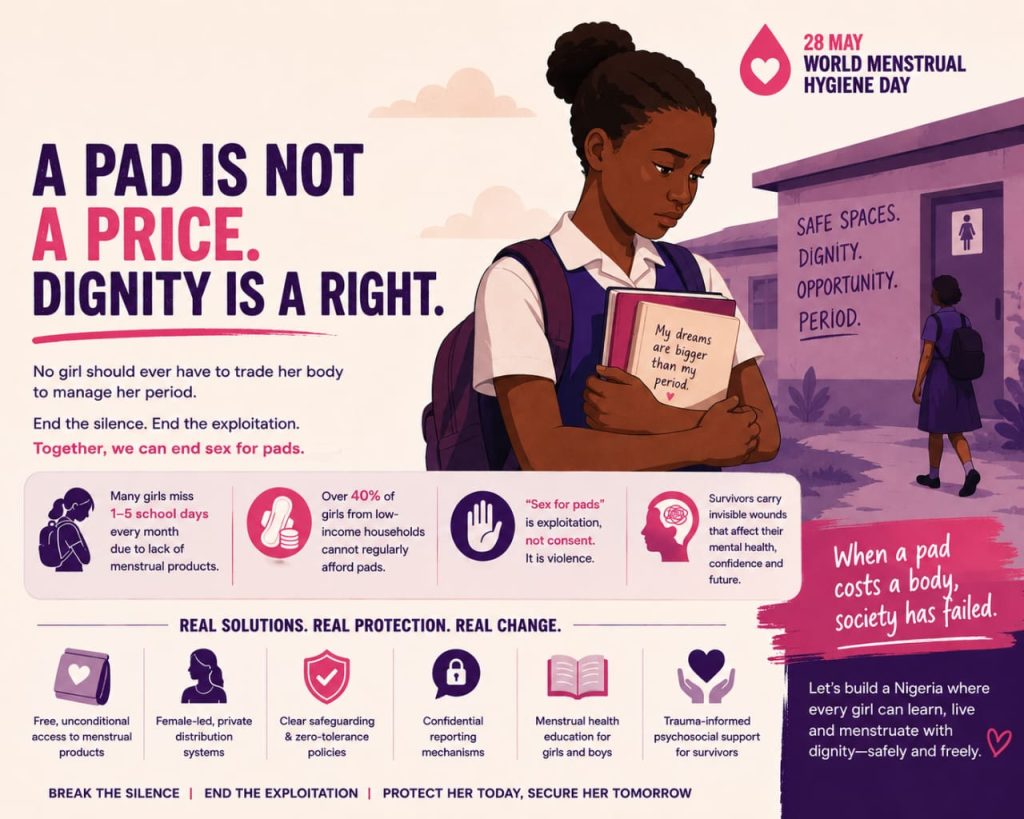
In Nigeria, where millions of girls reach puberty without reliable access to menstrual products, this risk is heightened. National surveys and education-sector reports have consistently shown that a large proportion of Nigerian schoolgirls miss between one and five school days each month due to menstruation, with affordability of pads, lack of water and sanitation facilities, and fear of stigma cited as leading reasons. Civil society estimates further suggest that over 40% of girls from low-income households cannot regularly afford sanitary pads, pushing them toward unsafe alternatives or dependency on others. National and civil society data consistently show that a significant proportion of Nigerian girls miss school during menstruation, largely due to lack of pads, water, privacy, or disposal facilities. Period poverty is most acute among girls from low-income households, rural communities, and internally displaced persons (IDP) camps—contexts where protection systems are weakest and power imbalances most extreme.
What “Sex for Pads” Really Is
“Sex for pads” refers to situations where girls or women are coerced—directly or indirectly—into exchanging sex for menstrual hygiene products or the money to buy them. The exchange may be proposed by peers, older men, teachers, vendors, or authority figures. Sometimes it is disguised as “help.” Sometimes it is framed as a “choice.”
But let us be clear: this is not consent.
Consent cannot exist where there is desperation. When a basic biological need becomes leverage, the transaction becomes abuse. Internationally, this is recognized as Sexual Exploitation and Abuse (SEA) and a form of gender-based violence (GBV)—particularly severe when minors are involved.
The Violence Hidden in Period Poverty
In Nigeria, menstruation intersects with broader structural failures. Despite policy commitments to girl-child education, menstrual health is still largely absent from education, health, and protection budgets. Many public schools lack gender-segregated toilets, running water, or disposal systems—conditions that push girls out of classrooms during their periods and deepen dependency on informal coping strategies.
Period poverty is not only about lacking sanitary products. It is about lacking options.
For many girls, menstruation already comes with silence and shame. In homes where periods are not discussed, in schools without functional toilets, and in communities that stigmatize menstruation, a girl’s monthly cycle becomes a monthly crisis.
When pads are unavailable or unaffordable, girls resort to unsafe alternatives—rags, tissue paper, leaves. They miss school. They withdraw socially. And in the most exploitative contexts, their bodies become bargaining chips.
This violence is “hidden” because it rarely leaves bruises. It hides behind silence, fear, and the normalization of male entitlement over female bodies.
The Psychology of Coerced Choice
From a psychological perspective, sex-for-pads thrives on power imbalance.
A girl who needs a pad is not negotiating from a place of equality. She is negotiating from a place of urgency, shame, and fear of exposure. Her brain is in survival mode. The question is no longer “Is this right?” but “How do I get through today?”
Over time, repeated coercion erodes a young person’s sense of bodily autonomy. Many survivors internalize blame—believing they “agreed,” even when no real alternative existed. This self-blame deepens trauma and delays help-seeking.
The Mental Health Cost We Rarely Talk About
The psychological impact of sex-for-pads extends far beyond the moment of exploitation.
Survivors often experience:
- Chronic shame and guilt
- Anxiety around menstruation
- Depression and withdrawal
- Difficulty trusting others
- Confusion around consent and boundaries
- For adolescents, whose identities and self-worth are still forming, this can permanently distort how they view relationships, intimacy, and their own value.
This is not just a menstrual health issue. It is a mental health crisis.
Why Giving Pads Alone Is Not Enough
In the Nigerian context, several documented cases of sexual exploitation have emerged in schools, informal settlements, and humanitarian settings, where access to basic needs is controlled by individuals with authority or influence. While not always reported as “sex for pads,” investigations into sexual exploitation and abuse (SEA) in aid and community settings reveal a familiar pattern: girls are expected to trade compliance, silence, or sexual access for essentials.
In response to period poverty, well-meaning initiatives often focus solely on pad distribution. While this is necessary, it is not sufficient.
In response to period poverty, well-meaning initiatives often focus solely on pad distribution. While this is necessary, it is not sufficient.
When pads are distributed without safeguards:
Those in control of distribution can abuse their power
Girls may still be coerced “off-record.”
Survivors have nowhere safe to report
Pads without protection can unintentionally reproduce the very exploitation they are meant to prevent.
What Real Solutions Look Like
Ending sex-for-pads requires an integrated approach—one that centers dignity, safety, and accountability.
Real solutions include:
- Free, unconditional access to menstrual products
- Female-led, private distribution systems
- Clear safeguarding and zero-tolerance policies
- Confidential reporting mechanisms
- Menstrual health education for girls and boys
- Trauma-informed psychosocial support for survivors
Most importantly, communities must stop treating menstruation as a private shame and start treating exploitation as a public crime.
Policy Implications for Nigeria
For Nigeria, ending sex-for-pads exploitation requires moving beyond ad-hoc interventions toward systemic policy action. Menstrual health must be treated as a public policy issue, not a private burden.
Key policy actions include:
- Explicit integration of menstrual health and hygiene (MHH) into national education, health, and adolescent development policies
- Dedicated budget lines for free menstrual products in public schools and humanitarian settings
- Mandatory safeguarding and SEA prevention standards for schools, NGOs, and aid programs
- Nationwide minimum standards for gender-segregated toilets, water, and disposal facilities in schools
- Government-supported referral pathways for survivors of sexual exploitation, including psychosocial care
Without these measures, girls will continue to pay for policy neglect with their bodies.
A Collective Responsibility
When a pad costs a body, society has failed.
Governments must fund menstrual health as a public good. Schools must protect, not exploit. NGOs and donors must pair distribution with safeguarding. Communities must challenge the norms that silence girls and excuse abuse.
And the rest of us must stop looking away.
Menstrual dignity is not charity. It is not a favor. It is a right.
Until no girl has to choose between bleeding in silence and being violated, the fight is not over.
As we mark Menstrual Hygiene Day 2026, we must remember that menstrual health is not only about hygiene; it is about dignity, protection, education, and human rights. No girl should ever have to trade her body for a basic necessity.
At the Dorothy Njemanze Foundation, we remain committed to advocating for safe access to menstrual products, safeguarding systems that protect girls from exploitation, and communities where menstruation is met with support—not shame.
Because periods should never cost a girl her safety, her education, or her future.
Smile Ndubuisi is a psychologist and trauma-informed mental health practitioner working at the intersection of gender, dignity, and psychosocial wellbeing at the Dorothy Njemanze Foundation Survivor Support Center.